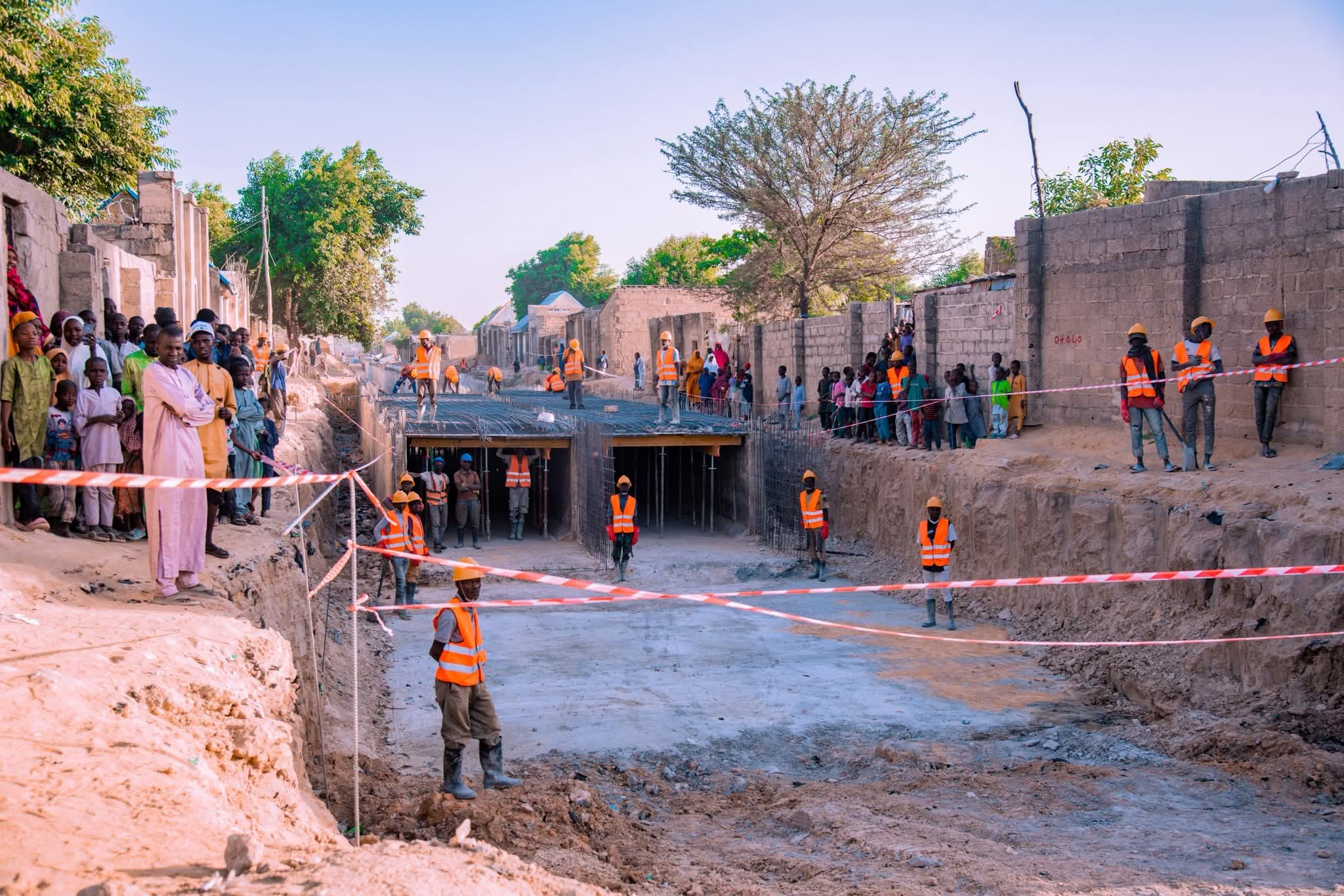
In a significant step toward strengthening climate resilience in northeastern Nigeria, Borno State Governor, Babagana Umara Zulum, has hosted a high-level World Bank delegation to assess progress on a major flood and erosion control project under the Agro-Climatic Resilience in Semi-Arid Landscapes (ACReSAL) initiative.
The delegation, led by World Bank Country Director, Dr. Matthew Verghis, alongside ACReSAL Task Team Leader, Dr. Joy Iganya Agene, carried out a detailed inspection of the Kogin Tipper flood control site—one of the most critical interventions targeting vulnerable communities in Maiduguri.
- Katsina recovers 30,000 hectares of degraded land, supports 2.5m beneficiaries through ACReSAL
- ACReSAL sensitizes Kano community on measures to check land degradation
The project, spanning 2.8 kilometres, is designed to address years of devastating flooding and erosion that have displaced residents and destroyed livelihoods in the area.
Ending Years of Devastation
For more than a decade, residents of Kogin Tipper have endured recurring floods that forced families to abandon their homes during the rainy season.
Commissioner for Environment, Engr. Mohammed Habib, said the project has reached an advanced stage and is set to permanently end the cycle of destruction.
“Before this intervention, rainfall meant evacuation. Families lost homes and stability year after year. What we see today is a turning point,” he said.
Beyond Construction: A Long-Term Vision
While acknowledging the progress made, Governor Zulum emphasized that sustainability remains a top priority. He announced plans to establish a dedicated watershed management agency to ensure long-term maintenance and effectiveness of ACReSAL interventions across the state.
The governor also called for the expansion of similar climate resilience projects to other at-risk communities, noting that the impacts of climate change continue to threaten livelihoods across the region.

Supervising Consultant, Engr. Julius Okezue, assured stakeholders that the engineering design of the project is robust and capable of permanently addressing flooding challenges in the area.
Strengthening Climate Partnerships
Commending the state government’s efforts, Dr. Verghis praised Governor Zulum’s commitment to development and environmental stability, describing the project as a model for climate adaptation in fragile regions.
The visit, attended by senior government officials including the Secretary to the State Government and members of the State Executive Council, reinforced the partnership between Nigeria and the World Bank in tackling climate-induced challenges.
Stakeholders say the Kogin Tipper project represents more than infrastructure—it is a lifeline for communities long trapped in a cycle of climate vulnerability.
With its completion in sight, residents are hopeful that the era of annual flooding and displacement may soon become a thing of the past, replaced by stability, safety, and renewed economic opportunity.