


By Zahraddeen Yakubu Shuaibu
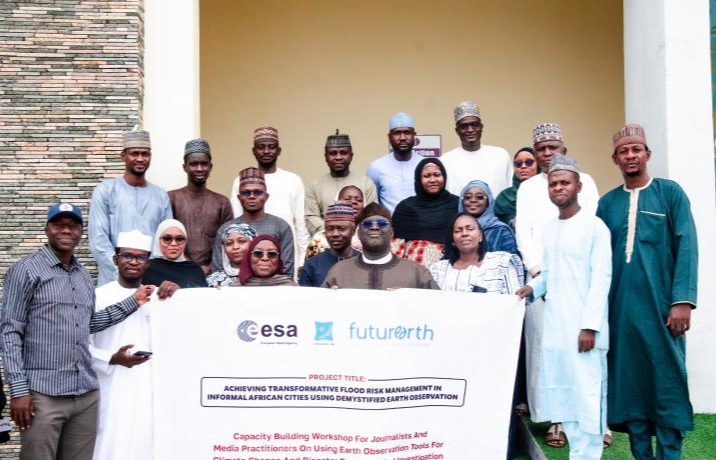
The Center for Dryland Agriculture (CDA) of Bayero University Kano (BUK), has trained journalist and equipped them with cutting-edge skills in Earth Observation technologies to improve reporting on climate change, disasters, and environmental sustainability.
The training, supported by international partners including the European Space Agency (ESA) and Future Earth, brought together media practitioners under a project titled “Achieving Transformative Flood Risk Management in Informal African Cities Using Demystified Earth Observation.”
- CDA hosts farmers’ training on adoption of agricultural biotechnology crops
- EDITORIAL: Earth Month: What you need to know and why it matters now more than ever
It focuses on helping journalists translate complex scientific data into clear, impactful stories that inform the public and support decision-making.
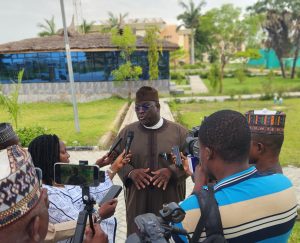
Speaking at the event, the Project Lead, Professor Aliyu Salisu Barau, said the training was designed to bridge the gap between science and society towards simplifying technical terms and using them in reporting issues related to the environment.
“The media is the bridge between science, society, and policy. Scientific knowledge often comes in complex language, but when journalists understand and simplify it, they can take it to the public in ways that drive action,” he said.
He explained that Earth Observation technologies—such as satellite imagery, remote sensing, and geospatial data—offer journalists powerful tools for investigative and data-driven reporting.
According to him, although there is a wealth of scientific knowledge in Earth Observation, it must go beyond academic spaces and reach the wider public to make real impact.
“We shouldn’t keep knowledge in the university. It should be shared with the public for better results. We can only achieve that through this kind of training for journalists.”
Also speaking, the Deputy Vice-Chancellor (Research and Development), Professor Amina Mustapha, described the training as timely, noting that Northern Nigeria and the wider Sahel region are already facing the harsh realities of climate change, including desertification, shrinking water bodies, and unpredictable weather patterns.
She urged journalists to embrace solutions journalism and focus on local realities often overlooked in climate reporting.
Similarly, in her virtual presentation, Freya Muir, Research Coordinator and European Space Agency (ESA) Liaison for Future Earth, highlighted how technology and Earth Observation systems can be harnessed to improve climate simulations and support better environmental decidecision-makig.
Agro Climate News reports that the workshop provided participants with practical knowledge on integrating geospatial data and satellite-based information into investigative and environmental reporting.
Participants commended the organisers for the initiative and pledged to apply the knowledge gained to strengthen evidence-based journalism and combat fake news and misinformation related to climate change and environmental issues.

 of Bayero University Kano (BUK), has trained journalist and equipped them with cutting-edge skills)