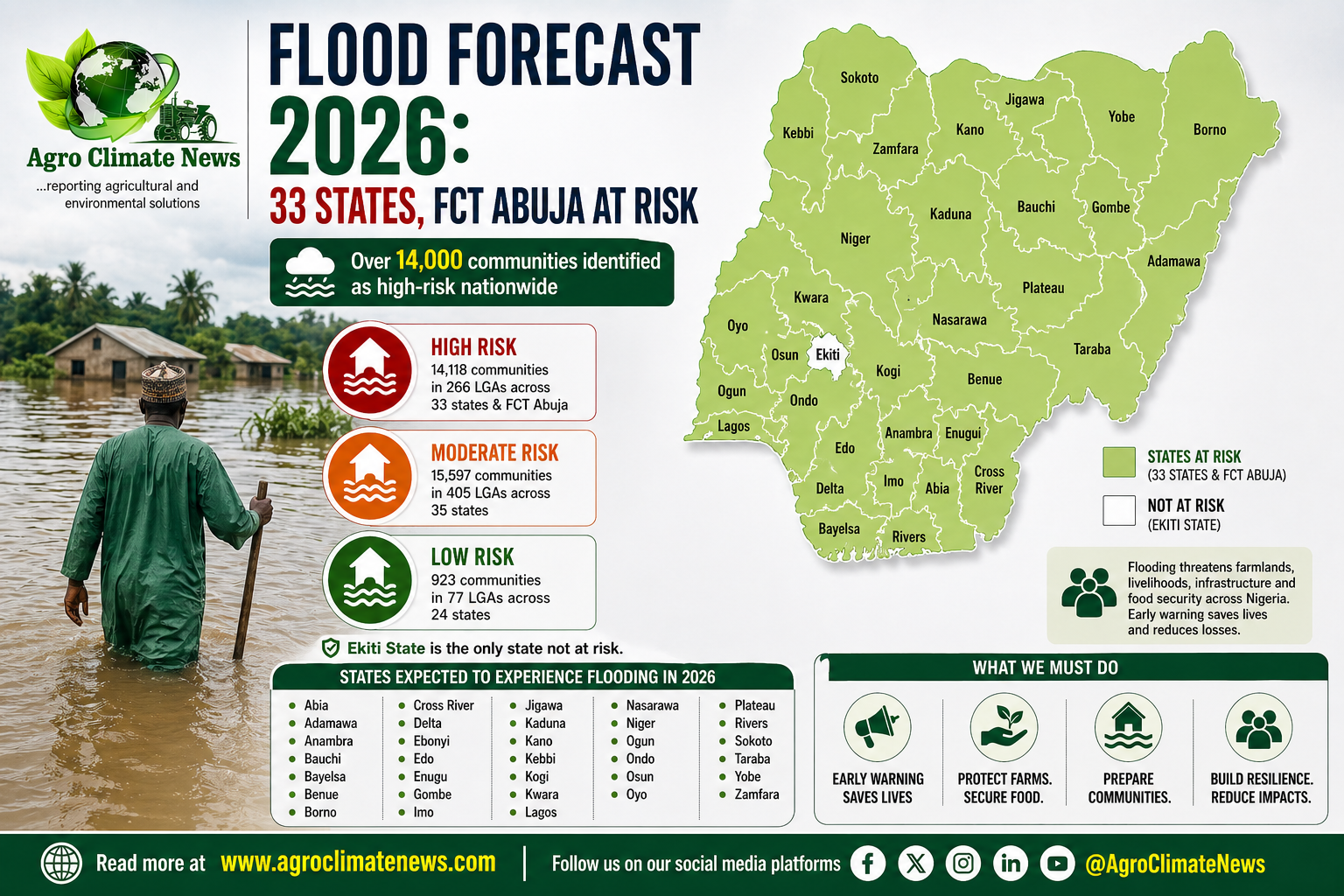
The 2026 flood warning by the Nigeria Hydrological Services Agency is clear: 33 states and the Federal Capital Territory are at risk of flooding. This is not just a report—it is a serious warning that affects farmers, families, businesses, and the entire economy.
Flooding has become a yearly problem in Nigeria. It destroys farms, displaces communities, spreads diseases, and increases food prices. If nothing changes, the impact this year could be worse.
- EDITORIAL: Earth Month: What you need to know and why it matters now more than ever
- FG reinforces proactive flood preparedness, food security at 2026 outlook launch
Entire communities have been displaced, farmlands submerged, homes destroyed, and livelihoods disrupted. In states such as Kogi State, Benue State, Bayelsa State, Anambra State, and Kebbi State, the impact of past floods still lingers in the form of lost harvests, damaged infrastructure, and economic hardship. The consequences go beyond immediate destruction—they also contribute to rising food prices, increased poverty, and public health concerns.
Yet, despite these realities, flooding does not have to become a disaster. With the right level of preparedness, awareness, and coordinated response, its effects can be significantly reduced. What is required now is a shift from delayed reaction to proactive planning.
In this editorial, Agro Climate News brings to before the public, government, and other stakeholders the measures to be adopted to avoid or reduce the risk of the flood.
What the Public Must Do
Citizens, particularly those living in vulnerable communities, must begin preparations early rather than waiting until floodwaters arrive.
People should pay close attention to official updates and early warning messages, treating them as important safety information rather than distant announcements.
Communities need to avoid settling or cultivating in areas known to be flood-prone, especially along riverbanks and natural waterways.
Residents should regularly clear blocked gutters, drainage channels, and waste that may obstruct water flow, as poor drainage often worsens flooding.
Families are encouraged to relocate essential belongings, documents, and farming inputs to safer and higher ground ahead of heavy rains.
It is also important for households to have a simple emergency plan, including safe exit routes and temporary shelter options.
Farmers, on their part, should adjust planting strategies by adopting early-maturing and flood-tolerant crop varieties, while also considering staggered planting to reduce risk.
Preparedness at the household and community level remains one of the most effective ways to reduce losses.
What Government Must Do
Government institutions at all levels have a central responsibility to protect lives and property through timely and decisive action.
Authorities must prioritise the rehabilitation and maintenance of drainage systems, especially in urban centres where flooding is often worsened by poor infrastructure.
There is a need for strict enforcement of environmental regulations, particularly those prohibiting construction on waterways and floodplains.
Governments should ensure that flood warnings and weather information reach communities in clear, local languages and in good time, allowing people to act before it is too late.
Agricultural support is also critical—farmers should be assisted with access to climate-smart inputs, irrigation support, and extension services that help them adapt to changing weather conditions.
Emergency management agencies must be adequately equipped and prepared, with designated shelters, relief materials, and rapid response systems ready for deployment.
Collaboration with agencies such as the Nigerian Meteorological Agency should be strengthened to improve forecasting accuracy and public communication.
Ultimately, effective governance in this context means acting early, communicating clearly, and responding swiftly.
What Other Stakeholders Must Do
Flood preparedness is not the responsibility of government alone. Other actors must also contribute meaningfully.
Media organisations should go beyond reporting by consistently educating the public on flood risks, safety measures, and adaptation strategies, especially in local languages.
Traditional and religious leaders play a vital role in influencing behaviour and should actively sensitise their communities on the importance of preparedness.
Non-governmental organisations and development partners should focus on supporting vulnerable populations with awareness campaigns, relief planning, and resilience-building initiatives.
The private sector can contribute by investing in sustainable infrastructure, supporting agricultural resilience, and partnering in emergency response efforts.
Educational institutions should incorporate basic disaster awareness and environmental responsibility into learning, helping to build a culture of preparedness from an early age.
A coordinated effort across all sectors will ensure that no community is left behind.
A Final Word
Flooding may be a natural occurrence, but the scale of its impact is largely determined by human action—or inaction. The 2026 forecast presents Nigeria with an opportunity: a chance to act early, prepare adequately, and avoid repeating the mistakes of the past.
This is not a time for complacency. It is a time for responsibility, cooperation, and urgency.
If citizens remain vigilant, governments act decisively, and stakeholders play their part, the country can significantly reduce the damage caused by flooding. Lives can be saved, farmlands protected, and communities preserved.
The warning has been issued. The next step is action—by everyone.