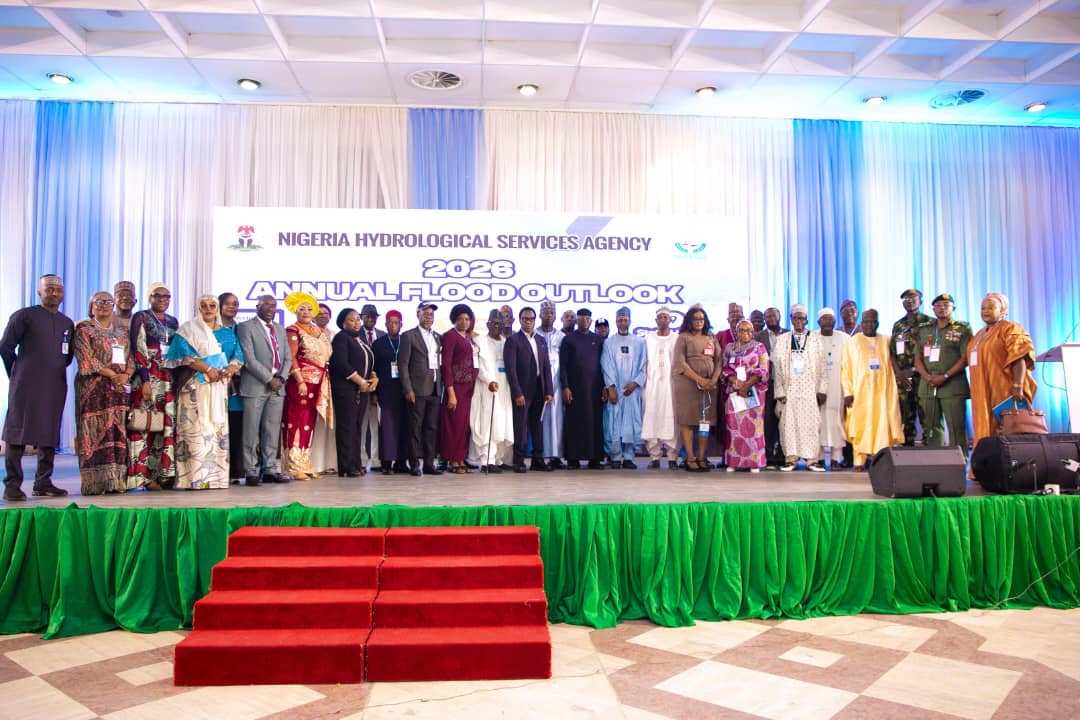
The Federal Government has reaffirmed its commitment to proactive flood management, food security, and economic diversification during the presentation of the 2026 Annual Flood Outlook in Abuja.
Representing President Bola Ahmed Tinubu, the Minister of Environment, Balarabe Abbas Lawal, said the event marks a key step in strengthening Nigeria’s resilience against flooding and climate-related disasters.
- Flooding: Abuja residents call for drainage clearing
- Experts analyse 2026 seasonal climate prediction to mitigate flood risks
In a statement issued by Agbajor Matthew, AD (Information & PR), for the Director (Information & PR) on Wednesday, the government noted that flood management remains a major national concern, with ongoing nationwide control projects targeting high-risk states such as Adamawa, Benue, Kogi, Bayelsa, Rivers, and Delta.
The government, he said, is shifting from reactive to proactive disaster response, especially after the 2024 Maiduguri flood.
He highlighted the introduction of an Anticipatory Action framework led by the Vice President’s Office, which has improved early warning systems and emergency preparedness.
He described the Annual Flood Outlook as a vital planning tool for mitigation and evacuation strategies, commending its early release ahead of the rainy season.
On economic diversification, the President urged relevant ministries to develop strategies for harnessing water resources to boost agriculture, improve food security, and reduce reliance on oil.
Minister of Water Resources and Sanitation, Joseph Utsev, disclosed that 14,118 communities in 266 local government areas across 33 states and the FCT are at high risk of flooding in 2026.
He added that 15,597 communities fall under moderate risk, while 923 are expected to experience minimal flooding.
The report identifies several states, including Lagos, Kogi, Rivers, and Bayelsa, as high-risk areas, and warns of increasing urban and coastal flooding. It also highlights improved forecasting systems and stronger collaboration with meteorological agencies.
Director-General of the Nigeria Hydrological Services Agency, Umar Ibrahim Mohammed, said new innovations such as AI-based modelling, a flood risk intelligence system, and a real-time alert dashboard will enhance flood monitoring and response.
The event brought together government officials, experts, and development partners, emphasizing the need for coordinated action.
It concluded with the official unveiling of the 2026 Annual Flood Outlook document by senior government representatives.