By Adam Said Adam, Kano
In communities once defined by dry soils, flooding fears, and farmer-herder tensions, a quiet transformation is unfolding—one that is now capturing national and global attention.
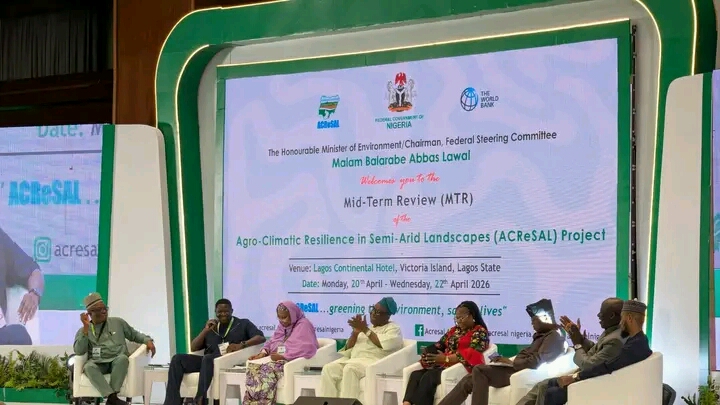
At a high-level gathering in Lagos, Nigeria’s flagship climate resilience initiative, the Agro-Climatic Resilience in Semi-Arid Landscapes (ACReSAL) project, is telling a powerful story—not just of targets met, but of lives changed.
- Restoring Hope: Zulum, World Bank inspect ACReSAL flood control project in Maiduguri
- Kano govt pledges support for climate startups to accelerate environmental solutions
As over 500 delegates from across 19 northern states and the Federal Capital Territory convened at the Lagos Continental Hotel for the project’s mid-term review, the message was unmistakable: ACReSAL is not only working—it is outperforming expectations.
“We are only halfway through, yet we have already surpassed our targets,” said National Project Coordinator Abdulhamid Umar.
Behind that statement lies a human story of scale and impact. The project has already reached about 9.3 million Nigerians—nearly three times its original target of 3.4 million—with women making up almost half of the beneficiaries. Across fragile landscapes, more than one million hectares of degraded land are now under restoration—achieved in just three years instead of the six initially planned.
But beyond the numbers are real changes in everyday life.
In Katsina, improved water systems are helping communities avoid the devastating floods that once destroyed homes and livelihoods each rainy season. In parts of Benue and Gombe, long-standing tensions between farmers and herders are easing, replaced by more peaceful coexistence and shared economic opportunities.
“We have impacted agricultural development and empowerment significantly,” Umar noted. “Young people are finding jobs, and women are gaining new sources of income. But the real story is best told by the beneficiaries themselves.”
For many attending the review, ACReSAL is becoming more than a project—it is emerging as a model for how climate action can directly improve lives.
Dr. Iganya Joy Agene of the World Bank emphasized that the mid-term review is not just about measuring progress but refining the path forward.
“This is our moment to reassess what is working, adjust where necessary, and ensure the project remains relevant in Nigeria’s changing realities,” she said. “We must also sharpen our focus on job creation as a key outcome.”
Other experts pointed to the need for innovation and deeper community involvement. Environmental specialist Nagaraja Rao Harshadeep stressed the importance of using advanced data and analytics to guide future investments, while Angela Armstrong highlighted the next phase—bringing large-scale environmental plans closer to the people through community-led initiatives.
“The real impact will come when communities take ownership of these investments,” Armstrong said.
There is also growing momentum for expansion. With discussions underway on additional financing, experts believe scaling up the project could unlock even greater benefits—lifting more people out of poverty while strengthening resilience against climate shocks.
“More funding will mean more livelihoods improved,” said Veronica Jarin of the World Bank.
As the three-day review continues, one thing is clear: ACReSAL is no longer just an intervention—it is becoming a blueprint.
From restoring degraded lands to rebuilding livelihoods and fostering peace, the project is showing what is possible when climate action meets community needs.
The challenge now is sustaining that momentum—ensuring that early successes are not only preserved but expanded, so that millions more Nigerians can share in the promise of a greener, more resilient future.