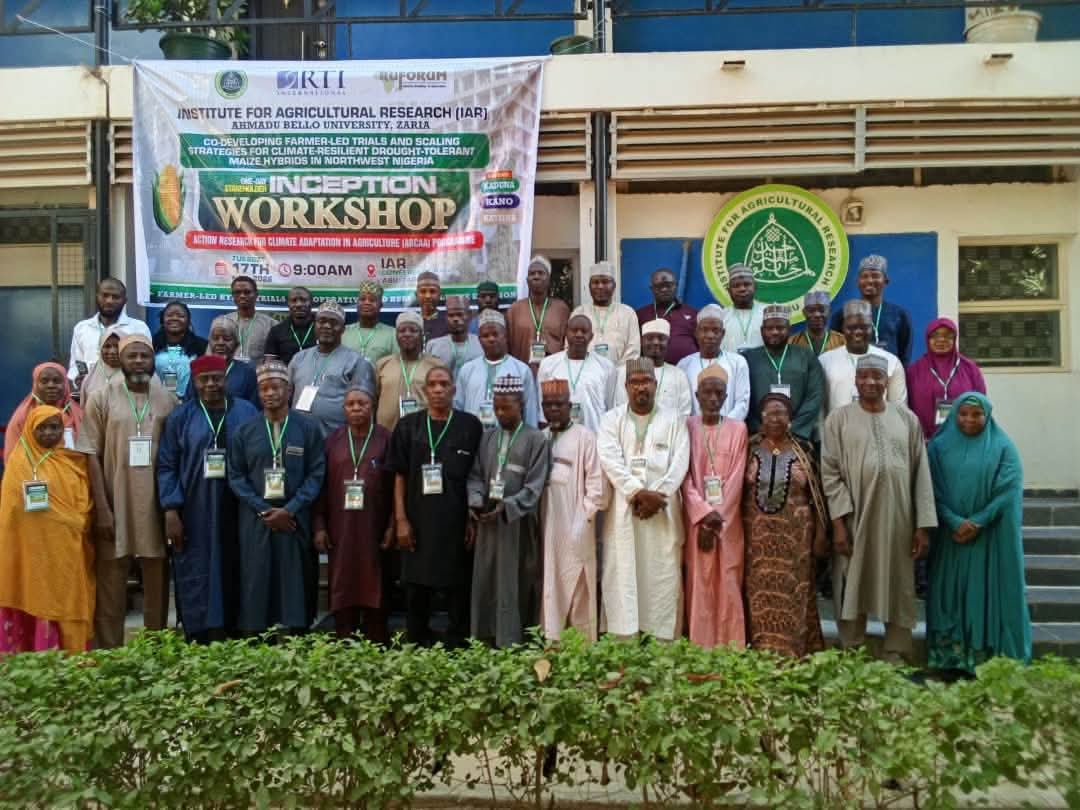
The Institute for Agricultural Research (IAR), Ahmadu Bello University (ABU), Zaria, has launched a collaborative research initiative aimed at developing and promoting climate-resilient, drought-tolerant maize hybrids to strengthen agricultural productivity and farmers’ resilience to climate change in Northwest Nigeria.
The initiative, implemented under the Action Research for Climate Adaptation in Agriculture (ARCAA) Programme, was unveiled at a project inception workshop held on Tuesday, November 17, 2026.
- IAR, ABU Zaria Emerges Overall Best Exhibitor at 2026 LCRI SeedConnect Exhibition
- IAR to develop fruit juice processing machine
The project, titled “Co-Developing Farmer-Led Trials and Scaling Strategies for Climate-Resilient Drought-Tolerant Maize Hybrids in Northwest Nigeria,” is being implemented in collaboration with RTI International and the Regional Universities Forum for Capacity Building in Agriculture (RUFORUM).
The workshop brought together agricultural stakeholders from Kano, Kaduna and Katsina States, including representatives of PM-NC, the African Agricultural Technology Foundation (AATF), Agricultural Development Programmes (ADPs), PM-MD/Regional Director, the Northwest office of the National Agricultural Seeds Council (NASC), and seed companies.
Speaking at the event, the Executive Director of IAR, Prof. Ado A. Yusuf, represented by the Assistant Director of Research, Prof. L. J. Bamaiyi, stressed the importance of collaborative research and farmer-centred approaches in developing and promoting agricultural technologies capable of addressing climate-related challenges.
He highlighted the need for stronger partnerships among research institutions, farmers and other agricultural stakeholders to ensure that innovations respond to the actual needs of farming communities.
The Principal Investigator, Prof. Yusuf U. Oladimeji, presented an overview of the project, outlining its objectives, implementation strategies and expected outcomes.
Other Co-Principal Investigators also delivered presentations on their respective areas of responsibility, providing participants with insights into the project’s technical components and implementation framework.
Discussions at the workshop focused on stakeholder collaboration, farmer-led trials and strategies for ensuring the effective implementation and wider adoption of drought-tolerant maize hybrids.
The organisers said the workshop provided a strong foundation for project implementation, with participants demonstrating commitment to the initiative and its expected deliverables.
The project is expected to contribute to strengthening agricultural research, improving farmers’ access to climate-resilient maize varieties and reducing the vulnerability of farming communities to drought and other climate-related risks.
With maize being an important staple and commercial crop across Northwest Nigeria, the development and adoption of drought-tolerant varieties could help farmers manage changing weather conditions, minimise production losses and strengthen regional food security.
The initiative forms part of broader efforts to promote climate-smart agriculture through research, innovation and farmer participation.