By Adam Said Adam, Kano
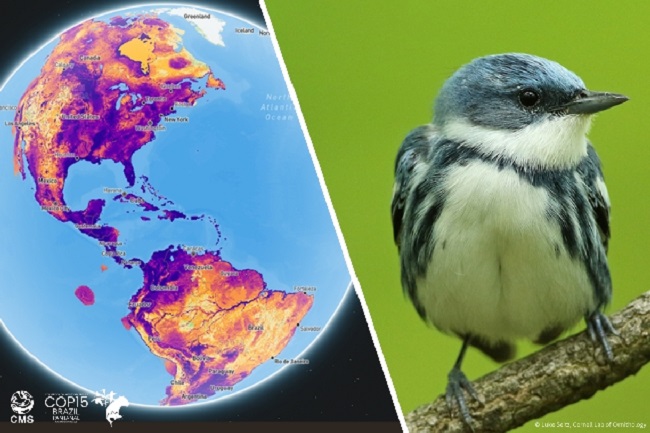
A new online tool mapping the full annual journeys of an initial 89 highly vulnerable migratory bird species across the Americas was unveiled on Thursday, March 26, 2026, at the UN wildlife conservation meeting, CMS COP15, giving governments, scientists and conservationists an unprecedented view of where action is most urgently needed to protect them.
Developed by the Cornell Lab of Ornithology and the Convention on the Conservation of Migratory Species of Wild Animals (CMS), the Americas Flyways Atlas pinpoints the critical breeding, stopover and wintering sites that migratory birds depend on to survive, many of which are under growing pressure from habitat loss, infrastructure and climate change.
- Plastic waste recycling market to hit $103.8bn by 2035 – report
- Burkina Faso bans fresh tomato exports to protect local processing industry
“invisible highways of the sky,” revealing critical habitats spanning 56 countries, offering governments a blueprint to halt bird declines
Drawing on many millions of citizen-science observations submitted through the eBird platform, combined with advanced scientific modeling, the Atlas identifies “Bird Concentration Areas” – key hotspots where high abundances of CMS Appendix I or II-listed bird species gather in large numbers at different stages of their migration.
The Atlas covers an initial 89 species listed under CMS Appendices I and/or II and comes at a moment of mounting concern over the state of migratory species globally. Across the Americas flyways, which stretch from the Canadian Arctic to Chile’s Patagonia, 622 migratory bird species rely on a fragile chain of habitats spanning 56 countries. Many are in decline.
From the Arctic-breeding Hudsonian godwit to the high-Andean flamingo and North America’s rapidly disappearing Cerulean warbler, these birds depend on multiple ecosystems across borders. A single weak link – a drained wetland, fragmented forest, disrupted stopover site – can jeopardise entire populations.
Enviro News reports that the Atlas makes those links visible for the first time at continental scale.
Unlike traditional datasets, the Atlas is designed to guide real-world decisions, helping governments identify where conservation efforts will have the greatest impact.
It directly supported negotiations at COP15, where 133 Parties debated new measures to protect migratory species, including proposals to list additional species and strengthen international cooperation on habitat protection and ecological connectivity.
By giving countries a shared evidence base, the platform aims to close one of conservation’s biggest gaps: aligning action across borders for species that do not recognise them.
The Atlas arrives as pressure intensifies on migratory species worldwide – from habitat destruction and infrastructure to pollution and climate disruption, all issues high on the COP15 agenda last week in Brazil.
Among species of migratory birds covered in the Atlas are some of the most iconic and ecologically important migrants of the hemisphere, including:
Buff-breasted Sandpiper (Calidris subruficollis), a Vulnerable grassland shorebird whose population has suffered rapid declines due to habitat loss.Semipalmated Sandpiper (Calidris pusilla), a Near Threatened long‑distance migrant facing sustained but poorly understood declines.Cerulean Warbler (Setophaga cerulea), a Near Threatened forest songbird whose breeding habitat continues to shrink and fragment.Andean Flamingo (Phoenicoparrus andinus), a Vulnerable high‑altitude species dependent on increasingly threatened Andean wetlands.Hudsonian Godwit (Limosa haemastica), a Vulnerable Arctic‑breeding shorebird reliant on a chain of sensitive stopover sites during its remarkable hemispheric migration.
These species exemplify the conservation challenges across the Americas Flyway, covering grasslands, shorelines, tropical forests, and high‑Andean lakes, and reinforce the need for coordinated international action.
“This atlas shows what becomes possible when millions of bird observations contributed by people across the Americas are brought together,” said Chris Wood, Programme Director of the Cornell Lab of Ornithology’s Centre for Avian Population Studies and eBird. “Combined with modern modeling, these contributions become a powerful tool for conservation. By turning these observations into clear maps of where migratory birds concentrate during breeding, migration, and winter, the Americas Flyways Atlas helps governments and conservation partners focus their efforts where they can make the greatest difference.”
CMS Executive Secretary Amy Fraenkel described the Atlas as “a major step forward for international cooperation on migratory bird conservation in the Americas. By bringing together cutting‑edge science and citizen‑generated data, this tool gives countries the information they need to identify and protect the places migratory birds depend on throughout their full annual cycles. Its launch at COP15 underscores our shared commitment to strengthening ecological connectivity across borders at a time when migratory species need coordinated action more than ever.”
Said João Paulo Capobianco, Chair of COP15 and Executive Secretary, Ministry of Environment and Climate Change, Brazil: “Presiding over COP15 in Brazil means driving multilateral cooperation that unites shared science and joint commitments for the future of life on the planet.”
“The Americas Flyways Atlas is a milestone in this strategy because it reveals, with unprecedented precision and clarity, the routes and key areas upon which the survival of migratory birds depends. By highlighting these ecological corridors that connect the biomes of the Americas, the platform becomes an irrefutable argument for more nations across our continent to join the Convention. Without protecting these stopover sites, migratory life throughout the hemisphere will be at stake,” added Capobianco.