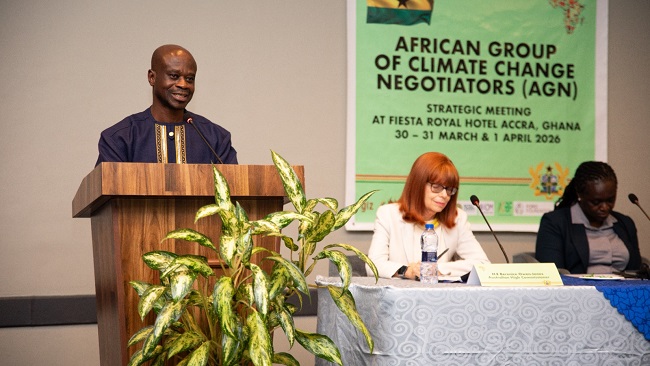
African climate leaders have convened in Accra for a high-level Strategic Meeting of the African Group of Negotiators (AGN), aimed at strengthening the continent’s unified position ahead of COP31 and COP32.
The three-day meeting, held from March 30 to April 1, 2026, brings together national focal points under the United Nations Framework Convention on Climate Change, African lead coordinators, and key development partners. It marks the first in-person strategic session under Ghana’s leadership of the AGN.
- At COP30, AfDB, development partners call for new financing to accelerate Great Green Wall initiative
- NiMet DG bags African Public Sector Leadership award in Ghana
Participants are working to develop a practical roadmap that will sharpen Africa’s climate priorities, improve coordination, and strengthen its negotiating influence within the global climate process.
Speaking at the opening, Nana Ama Browne Klutse, Chief Executive Officer of Ghana’s Environmental Protection Authority, stressed the urgency of unity in global negotiations. She noted that although Africa contributes the least to global emissions, it bears a disproportionate share of climate impacts, making equity and justice central to its demands.
The meeting is also historic, with Antwi-Boasiako Amoah assuming leadership of the AGN—the first time Ghana has chaired the bloc since joining the UN climate convention in 1992.
Delivering the keynote address, Baba Issifu Seidu highlighted that global climate negotiations have entered a decisive phase focused on implementation and accountability. He urged African countries to move beyond participation and actively shape outcomes across all negotiation tracks.
Key priorities outlined at the meeting include advancing the Global Goal on Adaptation, ensuring access to adequate and predictable climate finance under the New Collective Quantified Goal (NCQG), and protecting equity within mitigation efforts while supporting energy access and economic transformation.
Stakeholders emphasised that climate finance remains critical, warning that without sufficient funding, Africa’s adaptation and mitigation efforts could fall short.
The meeting features both open and closed sessions. Early discussions focused on Africa’s engagement with global platforms such as the G20, while subsequent sessions are expected to finalise negotiation strategies, assign responsibilities, and define next steps for the 2026–2027 climate cycle.
With Addis Ababa set to host COP32, the Accra meeting is widely seen as a crucial moment for Africa to consolidate its voice and influence global climate outcomes.
Experts at the meeting also highlighted the growing link between climate change and human mobility. Data from the International Organization for Migration shows that Sub-Saharan Africa recorded 19.3 million internal displacements in 2024, including 7.8 million caused by climate-related disasters.
Other speakers stressed the importance of scaling up adaptation efforts, particularly in agriculture, which remains central to Africa’s economy and food security.
As deliberations continue, Ghana reaffirmed its commitment to climate resilience and regional cooperation, expressing confidence that the outcomes will position Africa for stronger and more strategic engagement at upcoming global climate negotiations.
Alternative Headlines
Africa Unites in Accra to Shape Climate Strategy Ahead of COP31, COP32
Accra Summit Sets Stage for Africa’s Climate Negotiation Power Play
African Climate Negotiators Meet in Accra to Forge Unified COP Strategy
Africa Pushes for Climate Finance, Equity at High-Level Accra Meeting
From Accra to COP: Africa Strengthens Voice in Global Climate Talks
Short Editorial Angle (Optional Add-On)
Editorial: Africa Must Turn Climate Unity into Negotiation Power
The ongoing strategy meeting in Accra is more than a routine gathering—it is a defining moment for Africa’s climate diplomacy.
For decades, the continent has spoken with moral authority, highlighting its minimal contribution to global emissions and disproportionate vulnerability. Yet, outcomes from global negotiations have often fallen short, particularly on climate finance and adaptation support.
Now, as the world moves from pledges to implementation, Africa must transition from a position of advocacy to one of influence. Unity alone is no longer enough; it must translate into strategic leverage, clear demands, and measurable outcomes.
With COP32 set to take place on African soil in Addis Ababa, the continent has a rare opportunity to reshape the global climate agenda. The decisions taken in Accra could determine whether Africa remains a participant—or becomes a decisive force—in climate negotiations.