


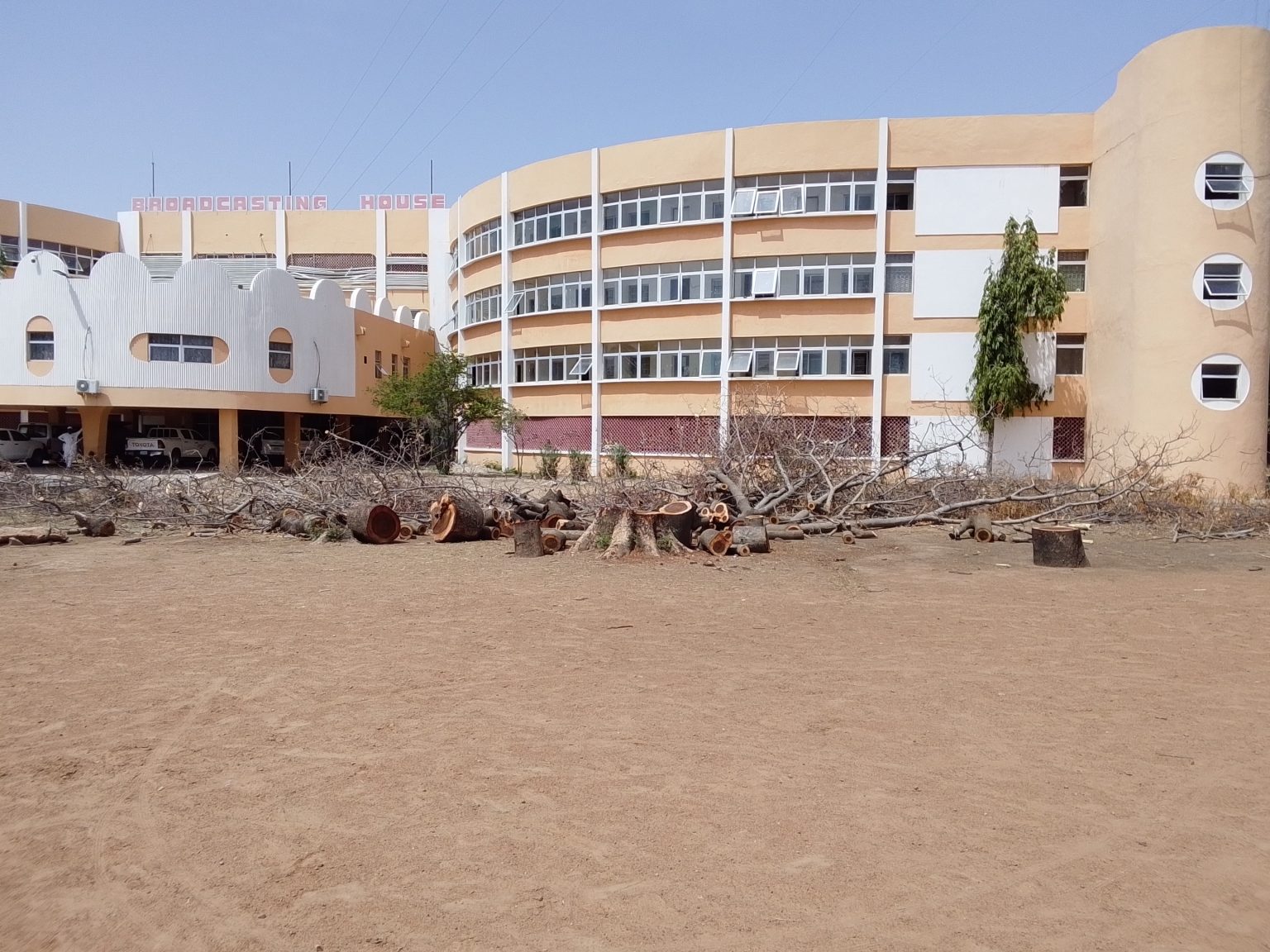
For decades, the premises of Abubakar Rimi Television (ARTV) in Kano stood as one of the city’s most prominent green spaces — a rare ecological refuge in an increasingly urbanised landscape. Towering trees, both indigenous and exotic, provided shade, moderated temperatures, supported biodiversity, and served as a natural buffer against the harsh realities of climate change in northern Nigeria.
Today, that legacy is rapidly fading.
- FEATURE: Early Rains, Uncertain Season: Farmers in dilemma as experts warn of possible dry spells
- Nigerian man, wife to pay $1m for illegally felling 38 trees in U.S
Residents of Hotoro and surrounding communities in Tarauni Local Government Area say the once-lush environment has been reduced to a shadow of itself, following what they describe as widespread and systematic felling of trees within the state-owned facility. Their concerns go beyond aesthetics — they point to a growing environmental crisis unfolding in plain sight.
Field observations by Agro Climate News reveal that large sections of the ARTV premises, once densely populated with trees, have been cleared. For years, the area hosted a diverse range of species including mahogany, neem, acacia, baobab (Adansonia digitata), eucalyptus, mango, and guava — trees that not only enhanced the ecological value of the space but also provided economic and medicinal benefits.
According to residents, many of these trees — some over three decades old — have now disappeared.
“We used to enjoy a much cooler environment here,” said Malam Ibrahim Adamu, a resident of Hotoro. “The trees acted as natural air conditioners. Now, the heat is becoming unbearable.”
His observation aligns with scientific evidence linking urban tree cover to reduced temperatures, improved air quality, and enhanced climate resilience in rapidly growing cities.
Allegations of Commercialisation
Beyond the environmental loss, allegations have emerged that the felled trees are being converted into firewood for commercial purposes. Residents claim to have witnessed trucks transporting large quantities of wood out of the ARTV premises.
While these claims could not be independently verified, findings indicate the presence of a firewood market located near the station’s perimeter — raising further questions about the fate of the harvested wood.
Some staff members of the station, who spoke anonymously, also expressed concern over the development. One source described the situation as “deeply troubling,” noting that trees that had stood for over 25 to 35 years were being cut down without clear justification.
Another source alleged that parts of the land were recently cleared to create space for a football field, despite the ecological importance of preserving mature trees.
Climate Implications for Kano
The loss of tree cover in urban centres like Kano has far-reaching consequences. Experts warn that unchecked deforestation contributes to rising temperatures, increased flooding risks, poor air quality, and loss of biodiversity — challenges already confronting many northern Nigerian cities.
In a region where extreme heat is intensifying due to climate change, trees play a critical role in regulating microclimates. Their removal not only accelerates warming but also reduces the resilience of communities to environmental shocks.
For residents of Hotoro, the impact is already being felt.
“The difference is clear,” Adamu said. “What used to be a cool and comfortable area is now much hotter.”
Action Contradicts Kano Climate Policy
The development comes at a time when the Kano State Government is actively promoting environmental protection. In recent months, authorities have introduced stricter measures to curb illegal tree felling, including a ban on unlicensed chainsaw use and the introduction of the Chainsaw Usage Permit Framework (CUPF).
Violators risk fines of up to N500,000, confiscation of equipment, and possible imprisonment. The state also enact a law that gives government the rights to punish offenders with two months imprisonment with and option of fine.
The state has also initiated a review of its forestry law — originally enacted in 1959 — to align it with modern environmental realities.
However, the situation at ARTV raises concerns about enforcement and accountability, particularly within government-owned institutions that are expected to lead by example.
Residents and environmental stakeholders are now calling on the Kano State Ministry of Environment and Climate Change to investigate the matter and take decisive action.
They argue that protecting existing green spaces is just as important as planting new trees — especially in urban areas where ecological resources are already under pressure.
“Government institutions should set the standard,” said one resident. “If this can happen here, what message does it send to the public?”
Government Responds, Orders Immediate Halt
Following public outcry and the circulation of a viral video showing the tree felling, the Kano State Government has ordered an immediate halt to the indiscriminate cutting of trees within the ARTV premises.
The directive was issued by the Commissioner for Information and Internal Affairs, Comrade Ibrahim Abdullahi Waiya, during an unscheduled visit to the station.
In a statement by the Director of Information in the ministry, Ameen Yassar, the commissioner described the development as contrary to the state’s environmental protection and climate change policies.
“I was disturbed by the viral video showing the indiscriminate felling of trees within the premises of ARTV. This action is contrary to the government’s policy on climate change and environmental sustainability,” Waiya said.
He warned that no tree should henceforth be cut within the station without obtaining official approval and consulting relevant government agencies.
Waiya also expressed concern over the broader implications of natural resource depletion, noting that such actions could have serious environmental consequences.
During the visit, the commissioner further raised issues regarding the operational performance of the station, stating that ARTV was struggling to meet viewers’ expectations due to outdated content and poor-quality news production.



 in Kano stood as one of the city’s most prominent green spaces — a rare)