By Lukman Abdulmalik
For several farming seasons, Aminu Sule watched the price of NPK and urea rise without seeing a comparable increase in the prices he received for the maize and tomatoes he harvested.
The farmer from Kura, Kano State, was trying to cut production costs. Instead, he stumbled upon an approach that could also increase the amount of food available from the crops he grows.
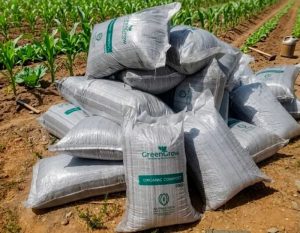
Two farming seasons ago, an agro-dealer introduced him to GreenGrow, an organic fertiliser processed from livestock waste. “I spent less on fertiliser and got better yields,” he said. “It means I have more to sell and more left at home for the family.”
In many farming households across northern Nigeria, the gap between what a family grows and what the family eats is frequently determined by how much of the harvest can be kept after input debts are settled.
When fertiliser costs fall and yields rise, that gap closes and the quality of what families eat improves alongside it.
It is a challenge public health experts have long recognised, and one that a small Kaduna-based company is now tackling through a practical solution being deployed across states in northern Nigeria.
Founded in 2021, Al Zira’a Tech uses livestock manure from abattoirs and farms lands, and processes it into a range of organic fertiliser, compost, and pesticide products distributed to farmers across northern Nigeria.
Why farm productivity matters for nutrition
Northern Nigeria carries a disproportionate share of the country’s malnutrition burden. The 2024 Nigeria Demographic and Health Survey found that 40 per cent of children under five were stunted and 8 per cent were wasted nationally, with the heaviest burden concentrated in northern zones.
Dr Abba Ibrahim, a public health specialist at Bayero University Kano, said the connection between farm-input costs and nutrition outcomes is important but often underestimated.
“When smallholder farmers produce more food at lower input costs, two things happen simultaneously. Household food availability improves, and more income is freed up for dietary diversification,” he said, adding that, “Both are critical pathways to reducing the stunting and wasting rates we continue to see in children across this region.”
Turning a sanitation problem into a food system solution
Musa Lawal collects livestock manure and other suitable organic material from Fagge abattoir in Kano and delivers it to processing facilities. Waste recovered through this arrangement becomes feedstock rather than being left unmanaged. The public health gains begin before the product ever reaches a farm.
These wastes were routinely left to decompose in the open, clogging drainage channels, attracting disease-carrying insects, and contaminating water sources in densely populated communities.
“The cities generate enormous volumes of organic waste that no one is using productively,” Farouk Mohammed Dalhatu, the founder and manager of the project, noted. “At the same time, farmers cannot afford fertiliser, so we saw a way to solve both problems together.”
The company says it sources suitable organic material from livestock farms, abattoirs, butchers and waste handlers in Kano, Plateau, Jigawa, Katsina, Niger and Kaduna states, as well as the Federal Capital Territory.
According to Dalhatu, about 80 per cent currently comes from Kano. Collected material is sorted, weighed, and passed through a biodigester where organic matter decomposes and releases methane gas, which the company redirects to power its operations.
The resulting liquid enters fermentation tanks, where organic components are introduced before the mixture matures into its final formulation. Odour-control and colouring agents approved for use are added ahead of packaging.
“Biodigestion, fermentation, maturity, and product adjustment are all necessary stages before it becomes GreenGrow,” he said. “Then we check smell, texture, consistency, and field performance, and send samples for laboratory testing where necessary.”
Dr Hadiza Shettima, a climate and agriculture specialist, noted that the soil health benefits of this process carries direct consequences for human nutrition.
“Organically processed livestock waste improves soil fertility, moisture retention, and microbial activity. These are not abstract benefits, they translate directly into more productive farms and more food available to communities.”
She also cautioned that prolonged reliance on synthetic chemical fertilisers progressively degrades soil structure, reducing long-term yields and threatening the food production base that rural households depend on.
“Organic inputs can reverse that damage. When soils recover, productivity recovers and that has a direct bearing on how much food families can grow or afford to buy.”
What has changed for farmers, and what remains unproven
Dalhatu noted that field observations and farm trials are showing yield increases of approximately 30 per cent for crops including maize, tomatoes, and vegetables, subject to soil type, rainfall, and application consistency. For Sule, the farmer in Kura, the impact is being felt at the dinner table.
“Before, after selling enough to cover what I spent on inputs, there was not much left. Now I keep more grain and we eat better through the dry season,” he said.
Al Zira’a Tech says more than 9,000 farmers are included in its distribution network, each representing a household where food production and consumption have shifted.
What responsible scaling would require
Al Zira’a Tech’s production base is in Kaduna, but the company has identified Kano as its next major expansion target. Dalhatu cited the state’s population size, agricultural scale, and the scale of its organic waste challenge as the rationale.
Dr Muhammad S. Khalil, Acting Managing Director of Kano State’s Refuse Management and Sanitation Board (REMASAB), Kano’s waste management authority, confirmed that commercial-scale organic waste processing in the state remains limited.
He added that companies from Saudi Arabia and the Netherlands have expressed interest in establishing composting plants in Kano, with the state government prepared to support private investors entering the sector.
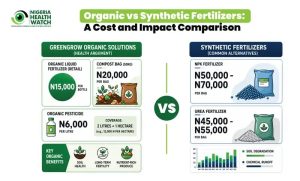
However, Al Zira’a Tech faces real obstacles. Synthetic fertilisers remain more familiar to many farmers and more widely distributed across rural markets. Seasonal production cycles also create cash-flow pressures, while limited access to capital constrains expansion across Nigeria’s agribusiness sector.
Dr Ibrahim argued that the public health community should pay closer attention to models like this one as a policy priority.
“We cannot nutrition-supplement our way out of a food system problem. The chronic undernutrition we see in northern Nigeria is not going to be resolved by clinic-based interventions alone. It requires making nutritious food more available, more affordable, and more reliably produced. And that starts in the soil.”
Dalhatu said the company was concentrating on organic material that it could trace through the livestock supply chain.
“At present, our requirements are met through the livestock supply chain. But the principle holds, organic waste gains valuable properties when properly managed. Whether it originates from a farm or an urban centre, the quality must be consistent.”
Consistency is essential, but the larger test is accountability. For this model to contribute meaningfully to food and nutrition security, it must demonstrate that the waste is processed safely, the products perform as claimed, farmers obtain a genuine economic return and increased production eventually results in healthier and more reliable diets.
(NigerianHealthWatch)