— Industry grows alongside government’s urban greening efforts
By Zahraddeen Yakubu Shuaibu, Kano
As the Kano State Government intensifies efforts to restore green spaces through the development of parks, gardens, and urban landscaping projects, the horticulture business in the state is experiencing renewed growth—prompting practitioners to call for the establishment of a dedicated “Green Village” to sustain the momentum.
The horticulture sector, once a largely overlooked trade, is now emerging as a critical player in Kano’s environmental sustainability drive and urban renewal agenda. With increasing awareness around climate change and the need for greener cities, demand for flowers, ornamental plants, and landscaping services has surged significantly.
- FEATURE: From Space to Story: How Earth Observation is Changing Climate Reporting
- EXCLUSIVE: Residents, Traders Lament as Scarcity of Soup Ingredients Hits Kano Markets
This growth is being reinforced by the state government’s recent commitment to beautifying the metropolis through tree planting, rehabilitation of public parks, and creation of new green areas across strategic locations.
Industry players say the renewed focus on greenery is not only improving the city’s aesthetics but also creating economic opportunities for hundreds of youths engaged in gardening, landscaping, and plant supply chains.
A veteran horticulturist, Baba Kabiru Lawan, noted that the business has evolved dramatically from its early days when patronage was limited to government agencies and expatriates.
“Back then, people were not used to planting flowers or trees. But today, with the awareness on environment and government efforts, the story has changed. More individuals and organisations now see the importance of greenery,” he said.
Across major roads, residential layouts, and institutional premises, gardens are flourishing—offering cooling effects, improving air quality, and enhancing the visual appeal of the city.
At Ni’ima Garden, located along the Bayero University Kano (BUK) axis, owner Sabi’u A. Umar said the sector is benefiting directly from both public and private investments in green infrastructure.
“The government’s efforts to bring back green spaces have really helped our business. At the same time, modern buildings now include gardens as part of their design, which increases demand for our services,” he explained.
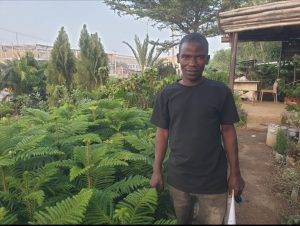
Umar added that beyond selling plants, horticulturists are increasingly being contracted by schools, hotels, estates, and government institutions to design and maintain landscapes.
“This has created another stream of income. Clients now engage us on monthly or yearly contracts to manage their gardens,” he said.
He disclosed that his business has expanded to multiple locations within Kano, employing about 20 workers, with plans to grow further as demand rises.

Similarly, Sani Iliyasu, popularly known as Sani Hisbah, who manages Albarka Garden near Aminu Kano Teaching Hospital (AKTH), highlighted the diversity and value within the sector.
“We have over 1,000 varieties of plants. Some are local and affordable, while others are exotic and expensive. The demand for modern flowers has increased, and that is driving the growth we are seeing today,” he said.
According to him, traders now source plant varieties from cities such as Abuja and Ibadan to meet rising customer demand.

Despite the gains, operators say the lack of a permanent site remains a major challenge threatening the sustainability of the business.
Most horticulturists operate on temporary spaces along road corridors or within unused plots, leaving them vulnerable to eviction and disruptions.
“We appreciate what the government is doing with green projects, but we also need support as business owners,” said Jamilu Abdulkareem, a garden operator.
“We don’t have a permanent place. At any time, we can be asked to leave. This affects our investment and long-term planning.”
Practitioners are therefore urging the state government to establish a dedicated “Green Village”—a central hub where horticulturists can operate permanently, access water, and expand their businesses.
They argue that such a facility would not only stabilise the sector but also enhance the state’s climate resilience efforts, attract investment, and generate more employment for young people.
“With a Green Village, the government will be supporting both the environment and the economy at the same time,” Abdulkareem added.
Government’s Green Agenda: From Tree Planting to Urban Landscaping
For the Kano State Government, the push for a greener city extends beyond beautification. The administration has increasingly linked tree planting, afforestation, land restoration and urban renewal with the broader objective of building a cleaner and more climate-resilient state.
One of the clearest indicators is the government’s 2025 tree-planting campaign, under which 5.5 million seedlings were distributed across Kano’s 44 local government areas. Governor Abba Kabir Yusuf directed local government chairmen to establish tree-planting committees and instructed that trees be planted in schools, religious centres and along streets. The government described the programme as part of efforts to combat desertification and promote environmental sustainability.
The administration has also sought to strengthen the infrastructure supporting afforestation. According to the state government, two major nurseries—at Mai Nikka in Gwarzo and Kafinciri in Garko—were rehabilitated after the government said there had been no functional shelter-belt nurseries in the state before 2023.
At the urban level, the government’s 2025 budget specifically provided for landscaping and green areas in eight metropolitan LGAs, as well as the remodelling of parks and gardens in Nassarawa GRA. The budget also included funding to increase tree planting under the afforestation programme.
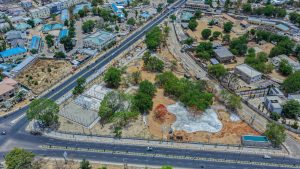
The state’s wider urban-renewal programme is occurring alongside these environmental interventions. In March 2025, Governor Yusuf flagged off the rehabilitation of 17 roads in the Kano metropolis as part of an urban-renewal programme aimed at transforming the city.